System makers
Build, maintain, distribute, document and govern the system as it changes.
Redefining an early-stage product around the people, workflows, and tools that make design systems work.
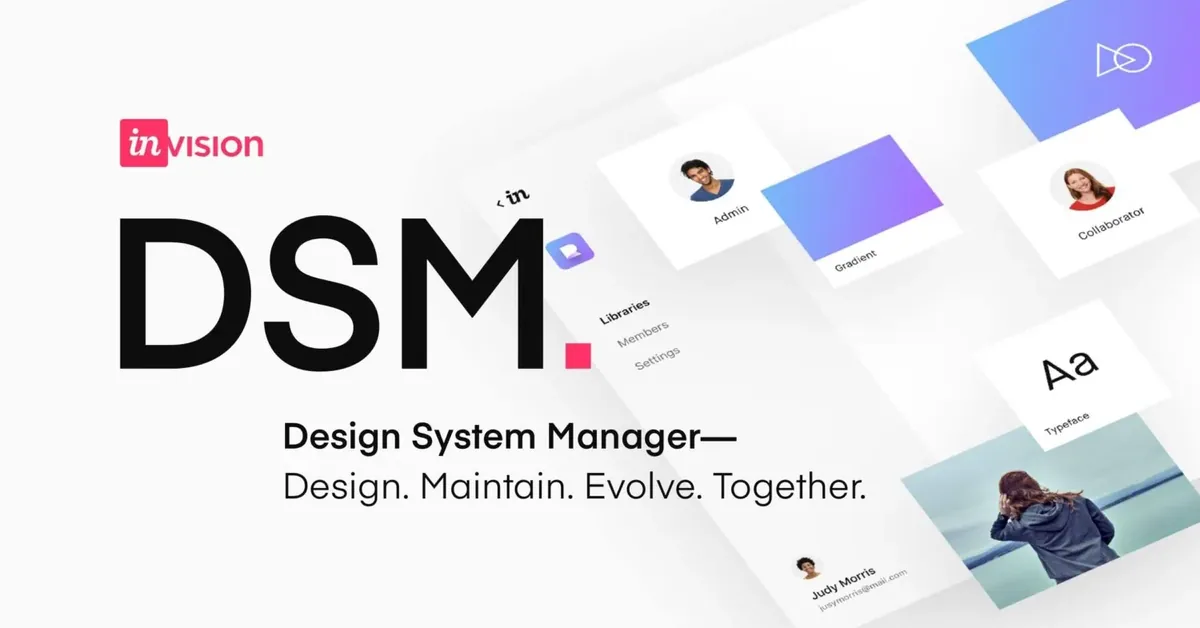
When I joined InVision in 2018, Design System Manager (DSM) was a young product born from an acquisition. The need for design systems was growing, but the right product experience was still taking shape.
I led design for DSM, guiding a fully distributed team through a complete overhaul of the experience. The work extended beyond product execution: I helped define the opportunity, align the organization around a direction, and bring that direction to market.
Research with hundreds of system makers and users, along with competitive analysis and close collaboration with InVision’s consulting and customer-facing teams, revealed two distinct audiences with interconnected needs.
Build, maintain, distribute, document and govern the system as it changes.
Apply trusted components and guidance in the tools where they design and develop products.
The opportunity was larger than storing reusable assets. It involved supporting the ongoing, cross-functional lifecycle of a design system.
I mapped the activities that happen as teams onboard, adopt, use, contribute to, and update a design system. Looking across roles and stages exposed manual work, fragmented handoffs and opportunities that a product could meaningfully support.
Mapping the recurring work between creating, consuming, and evolving a system exposed the gaps between roles and tools.
Simplified from the original lifecycle framework and customer journey mapping.
To build alignment on DSM’s strategy, I created frameworks that made the design systems space tangible to stakeholders who were less familiar with it. These helped us articulate both what teams needed and where DSM could provide value.
The maturity model helped position DSM as more than a library manager. A team just getting started needed education and foundational capabilities; a mature team needed distribution, governance, synchronization and visibility across disciplines.
Alongside frequent leadership conversations, these models helped secure executive support to invest in DSM as part of InVision’s broader platform.
Design systems are not simply component libraries. This model helped leaders see the broader collection of foundations, assets, code, documentation and governance that teams need to maintain together.
The platform model made the strategy tangible: design sources, code sources and system management needed to connect, without asking people to abandon the tools they already used.
Rather than moving straight into a roadmap, I led a vision process to align the team on an ideal future experience. I synthesized research, facilitated ideation and guided the team in creating a vision that could inform concrete product decisions without prematurely designing every detail.
Our vision extended beyond improving how teams created and documented design systems. We envisioned DSM as a connected platform that could support teams at every stage of maturity, from learning and establishing their first system to distributing components, synchronizing design and code, and measuring adoption.
At a time when design system tools largely addressed isolated pieces of that workflow, this was a fundamentally broader ambition: one platform that could grow with a team’s needs and connect the work of system makers and users.
DSM initially relied on a proprietary Sketch plugin for designers to define and use styles and components. As Sketch’s native Libraries evolved, customer feedback made it clear that DSM should augment those libraries instead of competing with them.
Designers managed system assets through DSM’s dedicated Sketch plugin.
DSM extended Sketch Libraries with the distribution, documentation and management experiences teams still needed.
This was not a small feature adjustment. It affected nearly every product surface. In partnership with Product and Engineering, I helped translate the vision into phased initiatives and a minimum valuable product, then refine the new model through alpha and beta programs.
DSM needed to work for different users in different tools while still feeling like one platform. I directed design across the ecosystem, with responsibility for coherence, quality and cross-team connections.
The revamped DSM launch met or exceeded its target metrics.
Leading design on an early-stage product meant doing more than defining screens. My contribution was making a complex domain understandable, creating organizational alignment around the right opportunity and giving a distributed team the direction to turn that strategy into an integrated experience.